








For fifteen years, the obvious answer to "build or buy" was buy. Off-the-shelf software cost a fraction of in-house development, shipped in weeks instead of quarters, and came with maintenance included. That logic shaped a generation of enterprise architecture: Salesforce owns the CRM, Workday owns HR, and the company organizes itself around whatever processes those platforms ship with.
The problem is that "ready-made" was never neutral. Every SaaS platform embeds a model of how work should be done, designed to serve as many different customers as possible — which in practice means generic enough to serve none of them perfectly. That trade-off made sense when building in-house was expensive and slow. In 2026, that premise started to crack.
What actually changed
The narrative that AI "killed" SaaS is overstated, but it's hiding a real shift. Agentic development tools have significantly cut the time and cost of building custom software — especially internal tools, automations, and integrations, where projects that used to take months now take weeks. And the bigger gain doesn't come from just handing developers AI tools; it comes from companies restructuring the entire development cycle around agents, from requirements to deploy.
That cost reduction, though, isn't uniform. It's substantial for well-scoped software. It's modest, sometimes negligible, for complex systems — intricate billing logic, multi-tenancy, regulatory requirements — where engineering judgment remains the bottleneck, not typing speed. Assuming you can now build anything in-house is oversimplifying.
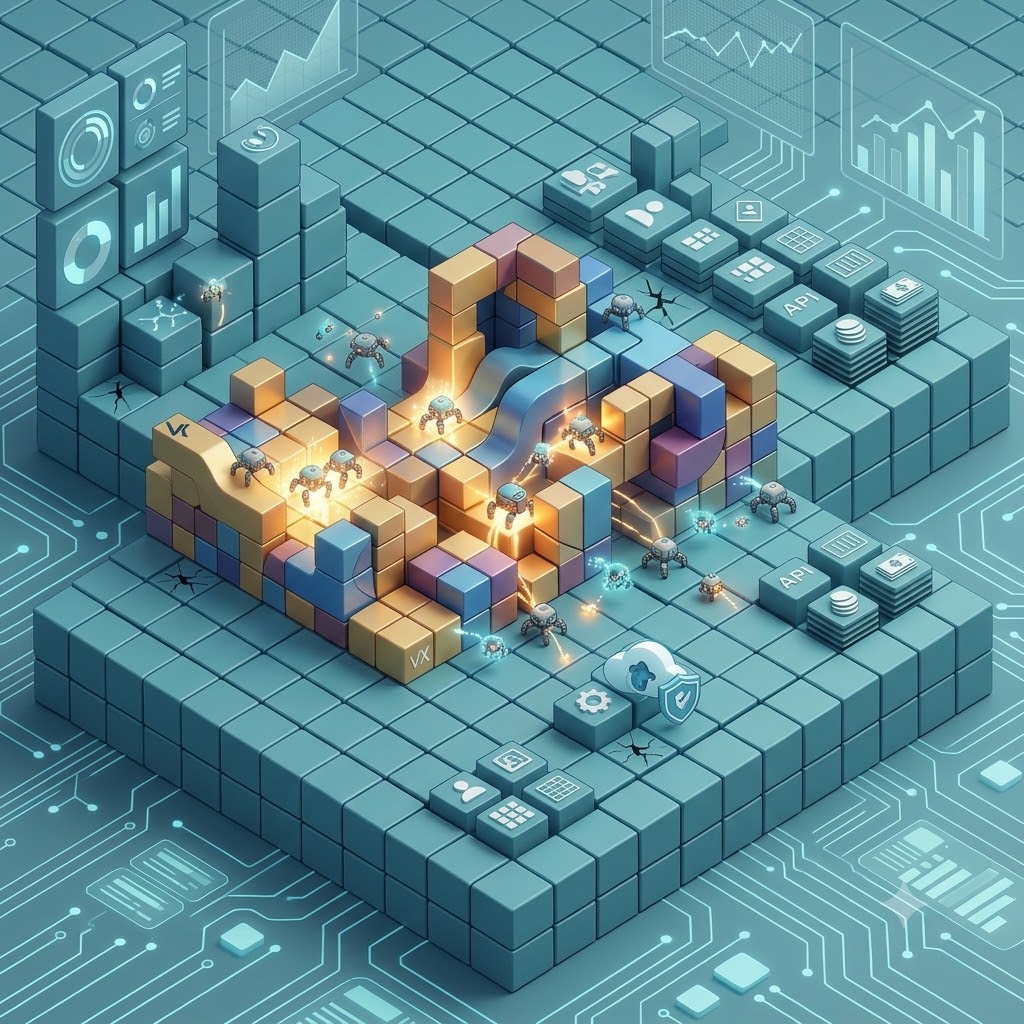
There's a second half to the equation: where SaaS still wins by a wide margin. Commodity categories — payroll, identity, cloud infrastructure — benefit from something no single company can replicate on its own: data scale across thousands of customers and an integration ecosystem that only exists because everyone runs on the same base. Core systems like ERP and CRM aren't going away; they're absorbing agentic capabilities and becoming the layer everything else runs on. Rather than dying, SaaS is turning into infrastructure.
The question that's shifting
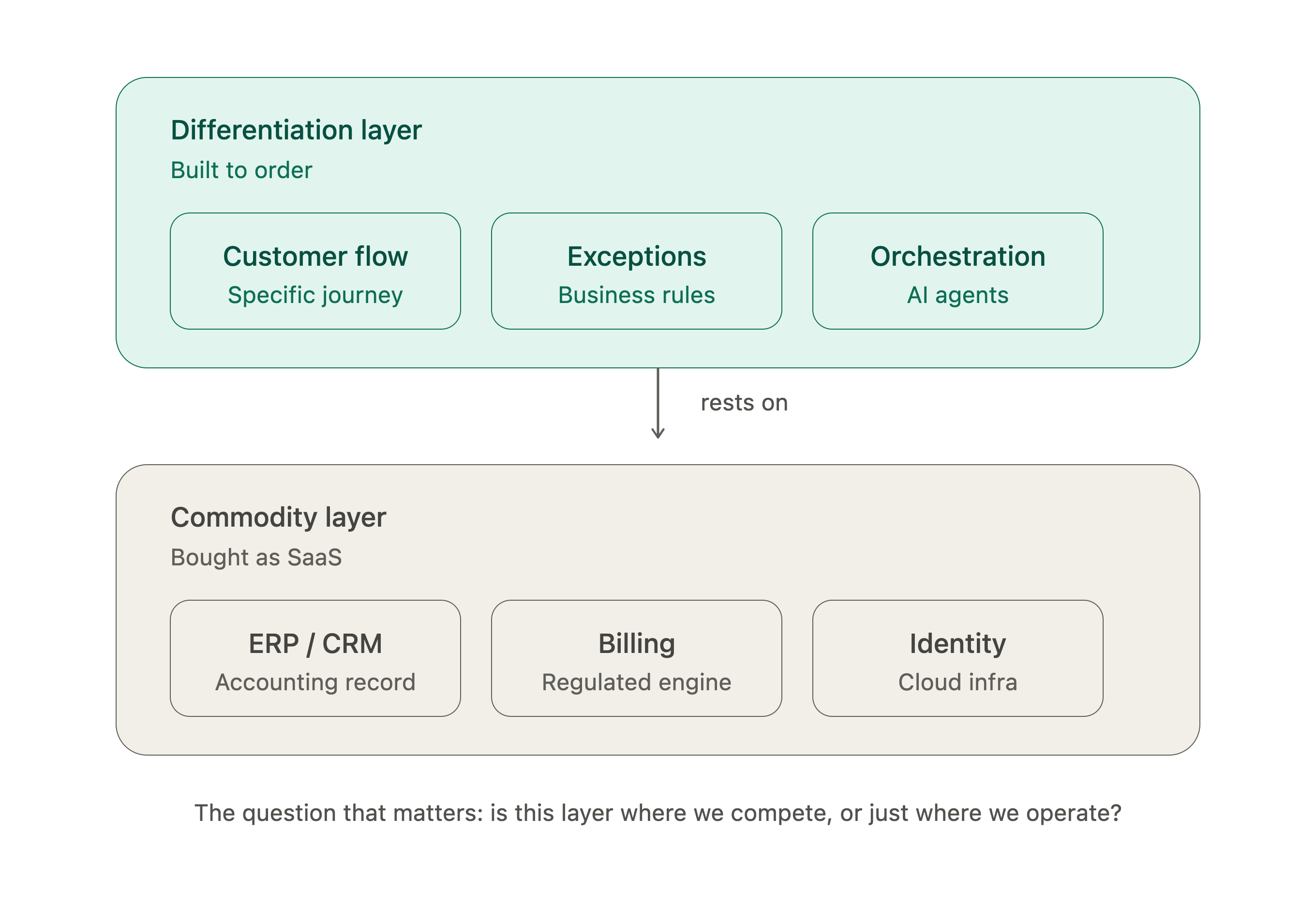
All of this moves the build-versus-buy decision. The question is no longer "do we build or buy this entire system" — it's "which layer holds our differentiation, and that's where it's worth building." Modern architectures already reflect this logic: AI platforms let companies register models, connect tools, and orchestrate agents on top of a commodity base without rebuilding that base from scratch. The goal isn't abandoning SaaS — it's not letting SaaS define the ceiling on what a company can do that's genuinely its own.
This is the pattern we see in legacy modernization work: the transactional core — the accounting ledger, the regulated billing engine, identity infrastructure — almost always stays bought, because differentiation there doesn't justify the risk of perpetual maintenance. But the layer that touches the customer, that orchestrates that company's specific workflow, that decides how exceptions get handled, has gained new momentum to be purpose-built — flipping the old logic where the company had to adapt to the software instead of the other way around.
This also explains why so many enterprise AI initiatives deliver less ROI than promised: most companies apply AI to workflows that already exist, automating the process inherited from generic SaaS instead of redesigning it. The real gain comes from rethinking the workflow from scratch, now that it's actually feasible to build exactly what the operation needs.
The risk of overcorrecting
Worth a counterpoint here. The enthusiasm for "build everything now that it's cheap" carries hidden costs. Broad research on IT projects shows that large internal initiatives have historically run nearly 50% over budget while delivering far less value than promised — a pattern AI accelerates but doesn't eliminate. Building faster doesn't mean maintaining cheaper: AI-generated code still needs an owner, tests, and security review. The real risk isn't buying too much anymore. It's building too fast, with no clear owner, quietly stacking up a new generation of technical debt dressed up as innovation.
The SaaS-versus-custom decision has become a continuous architectural call, revisited layer by layer. The question worth bringing to the leadership table isn't "do we buy or build this system" anymore — it's "is this layer where we compete, or just where we operate."
That distinction is what shapes how we think about modernization and digital transformation work at VX: before any architecture decision, asking what's operations and what's competitive edge.
References
Ready to accelerate your business with innovative software solutions?
Get in touch to discover how our custom software solutions can digitally transform your business.
Let's talk?