










Organizations that invest in technology share a recurring problem: the difficulty of evaluating the real return of a project before approving it. The conventional business case answers one question well — how much will this project save directly? — but systematically ignores dimensions that, in practice, determine whether the investment was sound.
The result is a distortion that cuts both ways. Projects with real strategic impact get rejected because the financial model failed to capture what was actually at stake. And low-impact projects get approved because they presented a clean, recognizable number.
At VX Technology, we developed a structured framework to organize this analysis. It does not replace the financial model — it corrects its most frequent blind spot: framing.
Why framing matters more than the number
The most common question in a budget approval meeting is "how much does it cost?". It is the wrong question.
The right question is "what is being evaluated?" — and answering it requires the decision-maker to identify which return dimensions the project generates, how predictable each one is, and what happens if the project is not done at all.
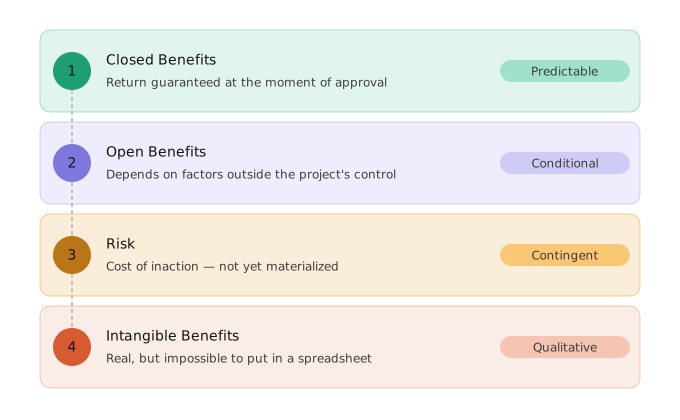
The VX 4-Layer ROI Framework organizes this analysis progressively: from the most predictable and immediate dimensions to those with the greatest long-term impact.
Layer 1 — Closed Benefits
Guiding question: if we do this project and nothing else changes in the business, what return is guaranteed?
This layer covers high-predictability returns — those that exist regardless of external factors: market behavior, commercial execution, or third-party decisions. The project is delivered and the benefit is there.
The most common examples include the automation of manual processes with a directly calculable reduction in operational costs, infrastructure migration with a before-and-after invoice, and the elimination of support contracts for discontinued systems with a payback defined before the project begins.
What defines this layer is not the type of benefit, but its predictability. Saving $10 million through process automation is different from increasing revenue by $10 million through a new platform — even if the numbers are identical on the slide. The first is closed at the moment of approval. The second is not.
If the answer to the guiding question is yes, the investment has a safe floor. If not, approval will depend on the layers that follow.
Layer 2 — Open Benefits
Guiding question: beyond approving this project, what other bets need to be made for the expected return to materialize?
This layer covers returns that are real and measurable after the fact — but contingent on variables outside the project's direct control. A personalization platform may significantly increase revenue, but that outcome depends on portfolio quality, pricing strategy, commercial execution, and market receptiveness. The project creates the condition. It does not deliver the result.
The practical distinction is this: closed and open benefits can carry the same nominal value in the financial model — and represent entirely different approval risks. An honest business case separates what the project delivers on its own from what it makes possible, and makes explicit the conditions that need to be met for open benefits to materialize.
A business case that does not answer this layer's guiding question is presenting the best-case scenario as if it were the expected one.
Layer 3 — Risk
Guiding question: if an incident happens two years from now, what will the cost be — and will anyone be able to explain why nothing was done before?
This is the most neglected dimension in ROI analysis — and frequently the most decisive for the decision. Risk is not about what the project might bring. It is about the exposure that grows every quarter the decision is delayed.
The calculation is straightforward: probability of the negative event multiplied by its cost. The challenge lies in bringing those numbers into the model — because no one wants to be the executive who presents a catastrophic scenario to justify an investment.
The most common risk sources in technology projects include security vulnerabilities in systems without active updates, dependency on individuals who hold undocumented knowledge, regulatory compliance that becomes more demanding each cycle, and critical platforms operating without vendor support.
The ROI of risk is not a positive return. It is the avoided cost of a loss that, statistically, will materialize. And the longer the decision is delayed, the greater the exposure.
Layer 4 — Intangible Benefits
Guiding question: if this project succeeds, what will the organization be able to do three years from now that it cannot do today — and what is that worth?
This is the layer with the greatest strategic impact and the least visibility in conventional financial models. Confusing it with irrelevance is the most frequent mistake made by decision-makers who operate exclusively with direct metrics.
The ability to attract and retain qualified professionals, speed of response to market shifts, quality perception that affects brand value, and expanded innovation capacity are all intangible benefits with real weight on the organization's competitive position. They explain why companies with similar fundamentals trade at such different multiples — the market prices them in, even if they do not appear directly in EBITDA.
The path forward is not to ignore them or pretend they are quantifiable in the same way as Layer 1. It is to treat them for what they are: strategic decision factors that need to enter the conversation with weight proportional to their real impact.
How to use the framework in practice
The most common mistake in applying any ROI framework is treating it as a validation step — a calculation done after the decision has already been made, to justify it internally.
The 4-Layer Framework works differently. It is a tool for structuring the conversation before the decision — and it should be conducted with business leadership, not just the technical team. The recommended process follows three steps:
The result is not a more precise number. It is a more honest conversation — and better-grounded decisions.
At VX Technology, we apply this framework as part of the business case process in legacy modernization projects, AI initiatives, and digital transformation programs. The way return is measured changes with context — but the four-layer structure and the questions it generates remain the same.
Ready to accelerate your business with innovative software solutions?
Get in touch to discover how our custom software solutions can digitally transform your business.
Let's talk?