










AI adoption across enterprises has accelerated sharply in recent years. In 2026, 64% of organizations report active use of AI in operations, according to an NVIDIA survey of more than 3,200 respondents. And yet, fewer than 20% of AI projects cross the threshold from pilot to production at scale. The rest remain indefinite proofs of concept — consuming budget and generating no measurable return.
The failure pattern is remarkably consistent. Technology is rarely the problem. What fails, in most cases, is how the system was designed to handle the unexpected.
The Exception Problem
Every automated process has a predictable behavior: it works well as long as cases fit the patterns it was configured for. The problem starts with exceptions.
An exception isn't necessarily rare. In middle-office processes — contract review, financial approvals, compliance, risk management — cross-industry analysis estimates that more than 40% of working hours are consumed by non-routine decisions. Nearly a quarter of those decisions depend on reasoning that no policy document fully captures. It lives in people's heads, accumulated over years of experience, refined through specific situations that never made it into a formal rule.
When an AI system encounters this kind of case, the default behavior is to escalate to a human. The human resolves it, the system moves on, and the next time a similar case arrives, the cycle repeats. The system never learns. The expert is never freed. The promised return never shows up on the bottom line.
A recent economic study that linked large-scale AI adoption surveys to administrative payroll records reached an uncomfortable conclusion: after two years of widespread adoption, the effect on working hours and revenue was statistically indistinguishable from zero. The time saved by automation was consumed by the work of operating the systems — reviewing outputs, correcting errors, manually wiring AI responses into actual decisions. True integration never happened.
The Missing Mechanism: The Resolution Loop
The difference between an AI system that delivers returns and one that doesn't rarely lies in the model. It lies in the mechanism for handling exceptions and relearning.
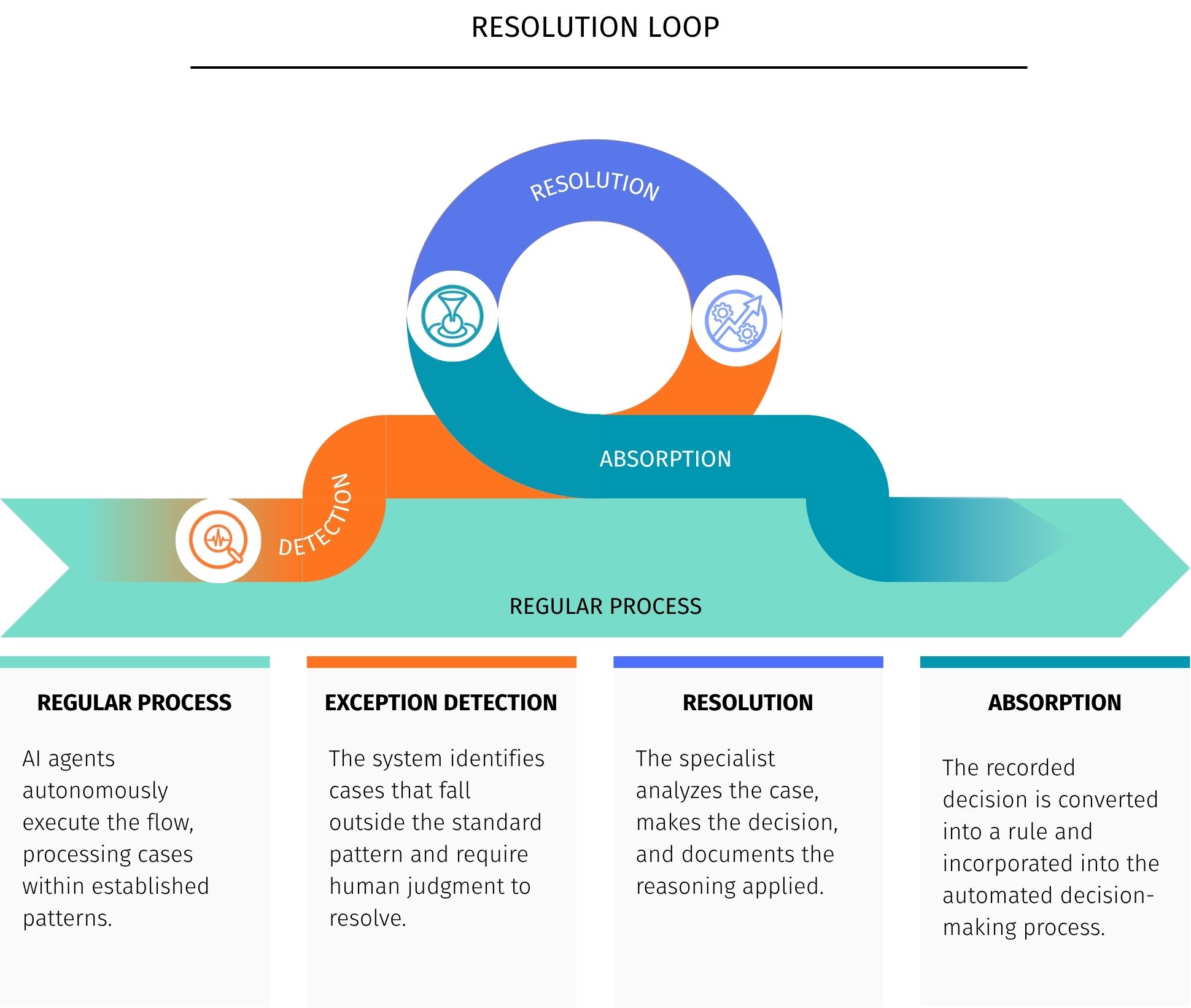
The Resolution Loop is the framework developed by VX Technology to address exactly this gap. The core idea is straightforward: instead of treating an exception as a deviation to be discarded, the system captures it, resolves it with the right expert, and absorbs it back into the process — turning what was an interruption into accumulated learning.
The mechanism runs on four continuous movements:
Processing — the system executes the process autonomously and efficiently for cases within known patterns.
Detection — when it encounters a case outside those patterns, the system flags it as an exception and captures the full context, rather than failing silently or simply routing the case to a human queue.
Resolution — the system surfaces a targeted question to the relevant expert, with enough context for a precise answer. The expert resolves the specific case and documents the reasoning applied.
Absorption — the resolution is converted into reusable knowledge and incorporated into the process. What was an exception is now handled automatically. The cycle restarts with a more capable process.
The effect is cumulative: each absorbed exception eliminates an entire category of future escalations. The system becomes more capable with every cycle — without requiring anyone to stop and retrain the model.
How It Works in Practice
In implementation, the loop operates across two complementary layers.
The first is a precedent base — a repository where expert resolutions are stored with structured context. Before attempting to resolve a new case, the system queries this repository: has something similar been resolved before? How? This layer allows prior reasoning to be recovered without having to reconstruct it from scratch each time.
The second is a layer of validated rules — the most recurring resolutions are distilled into explicit rules, reviewed by the expert before going live, and applied directly by the system to subsequent cases. This layer is more controlled and auditable: every rule has a traceable origin, can be inspected, and can be revoked if conditions change.
The critical point in any implementation is not the technology — it's the design of the capture interface. The tool the expert uses to log a resolution needs to be simple enough to avoid operational friction, yet structured enough for the system to generalize from what was recorded. This is where most projects fail: not in model selection, but in the quality of the capture mechanism.
What Happens When It Works
When the Resolution Loop is implemented correctly, results tend to be nonlinear. Experiments conducted in live operations have reported significant jumps: systems resolving 42% of cases reached 80% after implementing the relearning cycle. Cases classified as the most difficult went from 36% to 99% resolution, according to analysis by Accenture and Google published in Harvard Business Review in 2026.
The effect on people is equally significant. When the system starts handling routine exceptions, experts shift toward work that AI cannot do — decisions involving genuine ambiguity, judgment about novel contexts, relationships that require trust. MIT research on automation and labor found that when automation absorbs the routine parts of a role, the remaining work concentrates around harder-to-replace expertise — and tends to become more valuable, not less.
Where to Start
The practical recommendation is not to start with the most important or most visible process. It's to start with the process that has the right combination of three characteristics: high exception volume, high escalation cost, and decision logic that lives primarily in people's experience — not in manuals or systems.
These are the processes where the Resolution Loop has the most to capture and the most to offer. They are also the processes where the gap between current state and potential is largest — and where returns show up first.
The technology is ready. The question is whether the system was designed to learn — or only to execute.
_Data and references: Accenture and Google (cross-industry analysis on middle office and AI integration, HBR 2026), Deloitte (State of AI in the Enterprise 2026), NVIDIA (AI adoption survey 2026), McKinsey (State of AI 2026), MIT (research on automation and labor markets)._
Ready to accelerate your business with innovative software solutions?
Get in touch to discover how our custom software solutions can digitally transform your business.
Let's talk?