










The problem is not a lack of evidence — it's a lack of method
Every organization that has ever brought a strategic technology project to a budget meeting knows the moment of silence: the financial model is on the screen, the executive responsible for approval looks at the slide and asks — "how do we prove this return?"
The most common answer is a combination of hesitation and generalization. "It's hard to quantify." "The impact is strategic." "The market will recognize this in the long run."
And the project is not approved. Not because the impact does not exist. Because no one managed to translate that impact into language the board can evaluate with the instruments it has available.
This is the trap of intangible benefits. Not that they are invisible — on the contrary, any experienced manager sees and feels them in results over time. The problem is that _intangible_ can be confused with _nonexistent_ in the vocabulary of corporate business cases. And that confusion has a concrete, measurable cost, even if it rarely appears on any spreadsheet.
What makes a benefit intangible
An intangible benefit is not one that does not exist. It is one that cannot be measured directly with conventional accounting and financial instruments — but that affects in a real and lasting way the competitive position, market value, and operational capacity of the organization.
The distinction matters because it completely changes what you do next.
If the benefit does not exist, the right decision is to discard it. If the benefit exists but is difficult to measure with conventional instruments, the right decision is to find better instruments — or, in their absence, to find adjacent measures that capture the effect with enough precision to inform the decision.
The most recurring examples in technology projects include:
Ability to attract and retain talent. The quality of the technology environment has a direct impact on the organization's capacity to hire and keep high-performing professionals. Senior engineers and systems architects assess the company's technical state before accepting an offer — and resign when they realize the technical environment is compromising their professional development.
Speed of response to market. The ability to turn a strategic decision into a product or feature available to customers in weeks rather than quarters represents a competitive advantage that no spreadsheet row captures adequately — but that the market prices consistently.
Quality perception and brand value. A customer's experience with slow, unstable, or outdated systems affects the perceived value of the company as a whole, regardless of the intrinsic quality of the product or service offered. The reverse is also true: technological excellence communicates institutional capability.
Capacity to innovate. Organizations with modern technology foundations can experiment, iterate, and launch with a frequency that organizations with heavy legacy simply cannot replicate — regardless of budget or strategic intent.
Team morale and cohesion. Fragile systems, manual processes, and accumulated technical debt produce a silent erosion in the teams that operate them. This erosion manifests as falling productivity, increased errors, and eventually departures — but it rarely appears labeled as a direct consequence of a technical decision.
Client trust and institutional reputation. Operational incidents, instabilities, and systemic slowness affect the perception of the company's reliability among clients and partners in ways that go far beyond the immediate cost of the incident.
This list is not exhaustive. The central point is that all of these examples share the same characteristic: they exist, they affect results, but they do not appear directly in EBITDA. And all of them affect the multiple at which the company is valued.
Why financial markets already solve this problem
Before discussing method, it is worth observing that the sector that demands the most quantitative rigor — financial markets — has no problem pricing intangibles. It does so systematically, with billions of dollars of exposure.
A meaningful example: EVA (Economic Value Added), one of the most rigorous performance evaluation models in financial management, goes beyond accounting profit by discounting the opportunity cost of capital employed. In other words, a company only generates real value when its return exceeds the cost of all the capital it uses — including equity. EVA is precisely an attempt to bring accounting results closer to the true economic value generated by the company. And yet, even EVA does not capture intangibles such as institutional reputation, capacity to innovate, or quality of the work environment. This does not mean those factors are irrelevant to company value — it means conventional financial instruments have structural limits that capital markets learned long ago to work around.
The gap between book value (net equity recorded on the balance sheet) and market value of a technology company is, in large part, composed of exactly those assets that EVA does not capture: intellectual property, client base, team quality, capacity to innovate, competitive positioning. That gap is not treated as "unmeasurable" by analysts — it is modeled, estimated, and incorporated into valuation with specific methodologies. Capital markets, in short, already do the work of pricing what does not appear on the balance sheet. Internal technology investment decisions should do the same.
The difficulty is not in the nature of the benefit. It lies in the absence of a structured method to approach it.
The proxy method: operationalizing the intangible
The most robust approach for treating intangible benefits in business cases is the use of proxies — adjacent measures that capture the effect of a phenomenon without attempting to measure it directly.
A proxy is not a rough estimate. It is a deliberate methodological choice: identifying which observable, measurable variable is sufficiently correlated with the intangible benefit to serve as a legitimate representation of it in the decision process.
The difference between an honest proxy and a convenient one is transparency about its limitations. An honest proxy informs the decision without pretending to a precision it does not have. A convenient proxy selects the numbers that justify the desired conclusion. The distinction is both ethical and methodological — and an experienced decision-maker recognizes the difference.
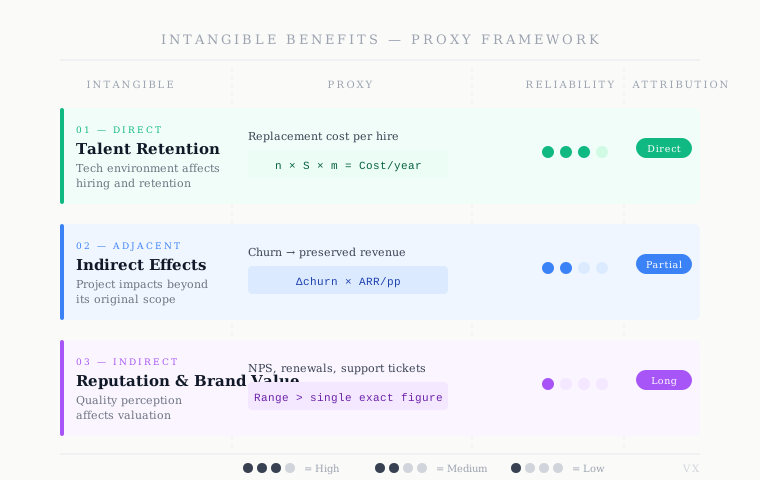
Example 1 — Talent retention
The intangible: the ability to attract and retain high-performing technology professionals.
The proxy: replacement cost per senior professional.
This is one of the best-documented proxies in management literature. Research from Gallup and analyst Josh Bersin converge on the finding that the total cost of replacing a senior professional ranges between 1.5x and 2x the position's annual salary, accounting for recruitment, selection, onboarding, learning curve, and productivity loss during the transition. For specialized technical positions, more recent studies suggest this multiple can reach 4x.
The calculation can be structured as follows:
$C_{replacement} = S_{annual} \times m$
Where S is the position's annual salary and m is the replacement multiple (1.5 to 2.0 for seniors; up to 4.0 for specialists). For a company losing n professionals per year, the total exposure is:
$C_{total} = n \times S_{annual} \times m$
Applying to a concrete example: two senior engineers (n = 2) with an annual salary of $120k each (S = $120k), conservative multiple of 1.5x:
$C_{total} = 2 \times \$120k \times 1.5 = \$360k/year$
At the upper multiple (m = 2.0), the cost rises to $480k annually. This interval — $360k to $480k — represents the direct exposure, without accounting for team morale impact, discontinuity in ongoing projects, or the time needed to rebuild technical capacity, rarely under six months for senior positions.
The payback of a modernization project that reduces technical attrition by 50% can be estimated as:
$Payback = \frac{C_{project}}{C_{total} \times r_{reduction}}$
Where r is the expected attrition reduction rate. For a $800k project with a 50% reduction (r = 0.5):
$Payback = \frac{\$800k}{\$360k \times 0.5} = \frac{\$800k}{\$180k} \approx 4.4 \text{ years}$
$Payback = \frac{\$800k}{\$480k \times 0.5} = \frac{\$800k}{\$240k} \approx 3.3 \text{ years}$
The projected payback range is 3.3 to 4.4 years — considering only this benefit, without accounting for any other effect of the project. What was intangible was the cause; the proxy transforms that cause into a manageable variable, with an associated cost that can legitimately enter the business case.
Example 2 — Adjacent effects and the attribution problem
The intangible: the indirect impact of a project on indicators beyond its original scope.
A technology project rarely impacts only the indicator it was designed for. The modernization of a customer service platform, for example, may reduce ticket resolution time — but that effect produces cascading consequences: churn reduction, NPS improvement, better brand perception. Each of those adjacent results has measurable value, but none of them was in the project's original scope.
The most honest proxy is to work with the indicator closest to the cause. Churn reduction, for example, has a calculable value: if the company retains $50k in annual recurring revenue per percentage point of churn reduction, and the project contributes to a 2-point drop, the projected impact is $100k per year in preserved revenue. The number is real — but the attribution chain between the project and the result passes through variables not entirely under the technical intervention's control.
This is the most honest and most difficult point in any intangible benefit analysis: how to attribute a result to a specific project when multiple factors contributed to it? The answer is not with certainty — it is with methodological rigor and transparency about the limitations. In practice, this means three things: attribute only the fraction of the effect reasonably imputable to the project, documenting the assumptions; measure the indicator before, during, and after the intervention; and present the benefit as a range — "between $60k and $120k in preserved revenue, depending on the degree of attribution" — rather than a single number that any experienced decision-maker will question. An honest range is more persuasive than fabricated precision.
Example 3 — Reputation and brand value
The intangible: institutional quality perception and its effect on valuation.
This is the example where the attribution chain is longest — and therefore where imprecision is greatest. A project that reduces a system's response time from 8 seconds to 1 second produces measurable effects on customer experience, which translate into NPS, repurchase rates, and referrals — and eventually into brand value. The chain is real. But attributing brand value directly to the specific technical project passes through enough intermediaries to make any precise figure methodologically questionable.
The right approach is to use short-term proxy results — NPS improvement, reduction in support tickets, increase in renewal rates — as partial evidence of the impact on institutional reputation, without claiming the total brand value as a project benefit. Precision decreases as the attribution chain lengthens. Acknowledging that limit explicitly is what distinguishes a serious analysis from a convenient one.
How to structure the conversation on intangible benefits
The proxy method solves the technical problem — how to measure. But there is an equally important presentation problem: how to introduce these numbers into an approval conversation without them appearing speculative or self-serving.
The structure that has worked best in executive decision contexts follows three moves:
First move — name and legitimize. Before presenting any number, name the intangible benefit and explain why it matters to the company's competitive position. Not as rhetoric, but as framing: "this benefit does not appear directly in the P&L, but it directly affects the multiple at which we will be valued in any M&A or fundraising process."
Second move — present the proxy with transparency about its limitations. The proxy is not the benefit. It is a measurable approximation of the benefit. Presenting it with that clarity — "this number is a conservative estimate based on the following data and assumptions" — increases the credibility of the analysis, not diminishes it.
Third move — calibrate the relative weight. Intangible benefits are rarely the decisive element on their own. Their role is to complement the analysis of tangible benefits — closed and open returns — with a strategic dimension that justifies approving projects whose tangible ROI is on the edge of acceptance.
The combination of these three moves shifts the conversation from "how much does it cost?" to "how much could it cost not to do this?" — which is the correct framing for projects with strategic impact.
Conclusion
An intangible benefit is not a nonexistent benefit. It is a benefit that requires a different method to be captured and presented.
Financial markets already know this. Best practices in strategic management already know this. What is missing, in most organizations, is a structured approach to applying that knowledge to internal technology investment decisions.
The proxy method does not solve all problems. But it solves the main one: it ensures that real, relevant benefits are not discarded due to the absence of a measurement instrument, when what is missing is simply a different framing.
Strategic projects deserve to be evaluated on the totality of their impact — not just the fraction that fits in a spreadsheet cell with two decimal places.
_VX works with business decision-makers to structure ROI analyses that capture the real impact of technology investments — across the four layers in which that impact manifests. If you'd like to explore this further, we're available._
Ready to accelerate your business with innovative software solutions?
Get in touch to discover how our custom software solutions can digitally transform your business.
Let's talk?