










There's an almost instinctive impulse when a company decides to modernize with AI: throw out the old and start from scratch. "This time we'll do it right."
Understandable. But rarely the right path.
Most legacy systems are still running because, at some level, they work. They carry decades of business rules, integrations, exceptions, and edge cases that were never documented — because they live in the memory of the system, not of the people who use it. Replacing them abruptly isn't modernization. It's concentrated risk with uncertain return.
The right question isn't _whether_ you'll modernize, but how — without destroying what already sustains the business.
AI as an Orchestration Layer
The architectural model that consistently works in modernization projects treats AI not as a replacement system, but as an orchestration and intelligence layer that operates _on top of_ the legacy, not _instead of_ it.
In practice, this means your 15-year-old ERP doesn't need to be rewritten to have a conversational interface. Your billing system doesn't need to change for a language model to help identify anomalies. The AI reads, interprets, suggests, and automates — but the data, the rules, and the critical processes remain exactly where they've always been.
This separation is both pragmatic and strategic.
It allows modernization to happen incrementally, with validation at each stage, without a single failure bringing down the system that sustains day-to-day operations.
Integration Patterns — and a Clear Hierarchy
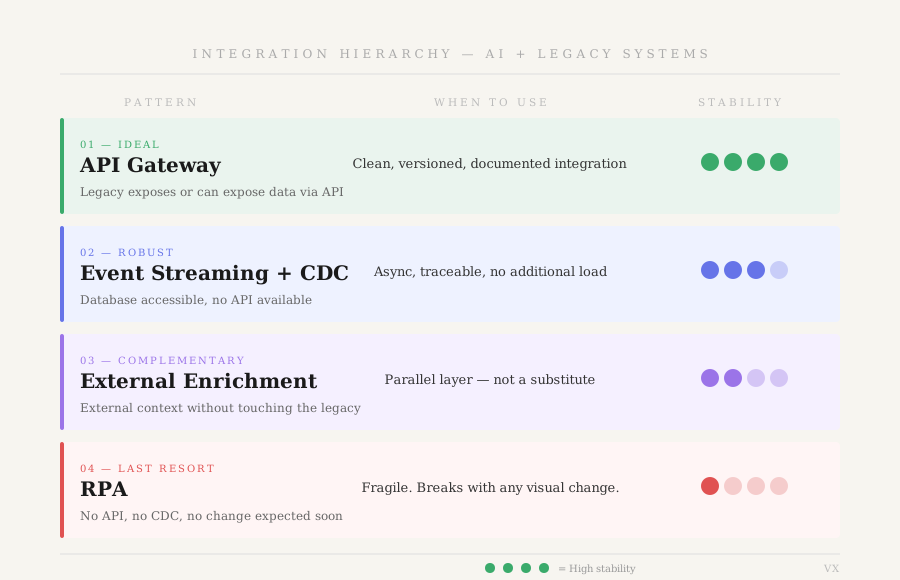
Before listing the patterns, it's worth establishing a guiding principle: always prefer integration that is closest to the data and furthest from the interface. The closer you get to the presentation layer — the screen, the form, the visual flow — the more fragile and expensive to maintain the integration becomes. This defines a hierarchy of preference that should guide every architectural decision.
1. API Gateway — The Ideal Pattern
When the legacy system exposes or can expose data via API, this is always the first choice. An API Gateway positioned in front of the existing system allows AI agents to consume data cleanly, stably, and in a versioned way — without touching the application's core. The integration is explicit, documented, and controlled. If the legacy system doesn't have an API today but the system allows building one, that's the investment worth making before anything else.
2. Event Streaming and CDC — Powerful When There's No API
When no API exists but the database is accessible, Event Streaming via CDC (Change Data Capture) is the most robust alternative. CDC reads the database's transaction log and transforms each change into an event — without modifying the legacy system in any way. Tools like Kafka, AWS Kinesis, or Azure Event Hub receive these events and make them available to AI pipelines in real time.
The legacy system continues operating exactly as before. The AI consumes the event stream without querying the database directly, without creating additional load, without any interface dependency. It's a clean and traceable integration — every event is recorded with a timestamp, which simplifies auditing and reprocessing.
The caveat: Kafka carries real infrastructure overhead. For low volumes or teams without experience in distributed systems, the operational cost may outweigh the benefit. But when volume and criticality justify it, this is the most solid approach available below a native API.
3. External Enrichment — Complementary, Not a Substitute
Not every integration needs to modify the legacy system or capture its events. When the system lacks context — customer sentiment, churn risk, digital behavior data — a parallel layer can process external signals and return scores and insights without altering a single line of the original database. The legacy CRM doesn't know everything, but the AI operating alongside it can. This pattern is complementary to the ones above, not an alternative to them.
4. RPA — Last Resort, With Explicit Caveats
When the legacy system has no API, doesn't allow CDC, and there's no realistic path to change in the near term, RPA enters as a last-resort alternative. An agent operates the system's interface as a human user would — reading fields, filling forms, triggering actions. The back-end doesn't change.
But the limitations are real: any visual change to the system — a repositioned field, a new modal, a layout update — can break the robot. Classic RPA also handles exceptions and ambiguity poorly. "Intelligent RPA," combined with computer vision or language models, expands the scope but also the complexity.
RPA makes sense when the process is repetitive, well-defined, and when no direct integration alternative exists. As a long-term strategy for critical systems, it's a workaround — useful while a more robust solution isn't viable, but never the first choice.
When Non-Invasive Integration Isn't Enough
There are situations where none of these patterns resolve the problem. And recognizing this limit early is just as important as knowing how to apply the techniques above.
When the legacy system _blocks_ data — not just hides it, but makes it structurally inaccessible — the AI has nothing to process. When there are no APIs and no capturable events, the integration becomes a fragile workaround. And when the system carries corrupted or obsolete business logic, the AI doesn't solve the problem: it amplifies it at scale.
In these cases, the intervention needs to go deeper. The criterion for deciding how deep is straightforward:
Is the limitation in the data or in the business logic?
If the problem is data access — missing APIs, proprietary formats, database isolation — the intervention can be surgical. There's no need to rewrite the system; just create windows. Connectors, adapters, read layers.
If the problem is incorrect or obsolete business logic — wrong calculations, flows that no longer reflect operational reality, undocumented circular dependencies — AI can help with diagnosis, but it doesn't replace refactoring. Language models can map dependencies, identify dead code, and suggest decomposition into services. But the decision to redesign the logic is managerial, not technical.
The Risks the AI Layer Doesn't Eliminate
Adding intelligence on top of a legacy system doesn't resolve the structural problems that system carries. Some risks deserve explicit attention:
Error amplification. If input data is incorrect or outdated, the model will produce incorrect outputs that look confident. AI doesn't fix bad data — it processes it at scale.
Technical debt accumulated in the integration layer. Every connector, adapter, and wrapper created to integrate AI with the legacy is code that needs to be maintained. Without architectural discipline, this layer becomes a new legacy faster than you'd expect.
Dependency on a fragile layer. When integration depends on RPA over a graphical interface, any visual change to the legacy system breaks the flow. Interface automations require active monitoring and a contingency strategy.
Model governance. As AI agents gain autonomy over critical processes, the need for traceability emerges: who authorized which decision, in which model version, with which data. This overhead is real and needs to be in the architecture from the beginning.
A Mental Model for Modernization Decisions
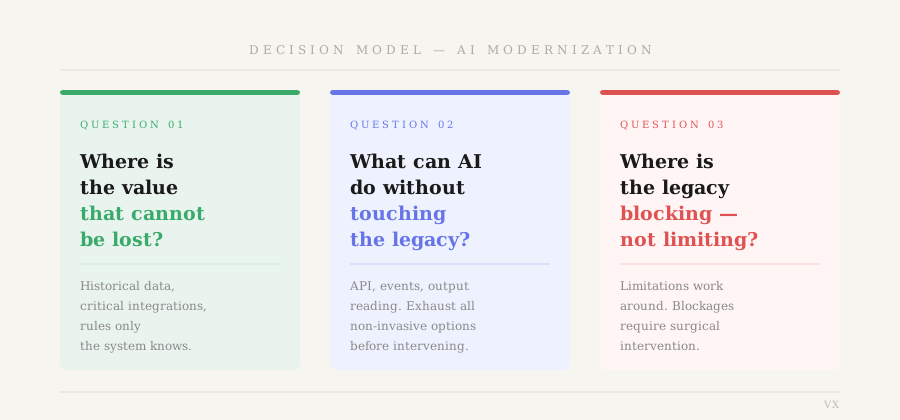
When evaluating AI modernization projects, three questions structure the analysis:
1. Where is the value that cannot be lost? Map what the legacy system carries that is irreplaceable — historical data, critical integrations, rules that "only the system knows." This mapping defines the protection perimeter before any intervention.
2. What can AI do without touching the legacy? Before any modification, exhaust the non-invasive possibilities. API layers, output reading, interface automation, parallel enrichment. Direct intervention is always the last resort.
3. Where is the legacy blocking — not just limiting? Limitations can be worked around with architecture. Structural blockages require intervention. The distinction between the two determines the scope and real cost of the project.
Modernization as a Journey of Layers
Modernizing with AI isn't a project with a defined beginning, middle, and end. It's a journey of layers — where each well-executed integration creates space for the next, where each layer of intelligence added increases the system's observability and reduces the risk of the following intervention.
Legacy systems aren't the enemy. They are the starting point — and frequently, the anchor that keeps the business running while modernization happens around them.
The most useful AI isn't the one that replaces. It's the one that converses with what already exists, understands its limits, and progressively expands what's possible.
_Inertia is the enemy. Legacy is just the context._
Ready to accelerate your business with innovative software solutions?
Get in touch to discover how our custom software solutions can digitally transform your business.
Let's talk?